Career Ready From Day One: Rethinking the First Year Experience
AI, a tighter job market, and doubts about academic rigor are pushing business programs to reconsider what students should learn first. The answer may be less about making the first year easier or harder, and more about making it matter.
Today's first-year undergrads face unusual pressures. AI is reshaping the entry-level jobs that once served as a training ground. Employers still look closely at transcripts but increasingly want more evidence that a candidate can think, communicate, and work with others and AI. Critics say grades are inflated and students aren't learning(Harvard College’s Grading System Is ‘Failing’). And many students arrive with study and work habits that won’t show up in a GPA but will surface quickly in college and at work.
As undergraduate business programs, rethink the first year, the debate tends to split into two camps. The first holds that the traditional Intro to Business course should remain intact, because students need to be exposed to the core business disciplines at the start of their journey to see the big picture. The second is more concerned with student wellbeing, sees how introductory courses are often taught, with heavy memorization and high-stakes exams, and worries they add stress without lasting value. For this camp, the first year should focus on professionalism instead: study habits, organizational skills, resumes, and interview preparation.
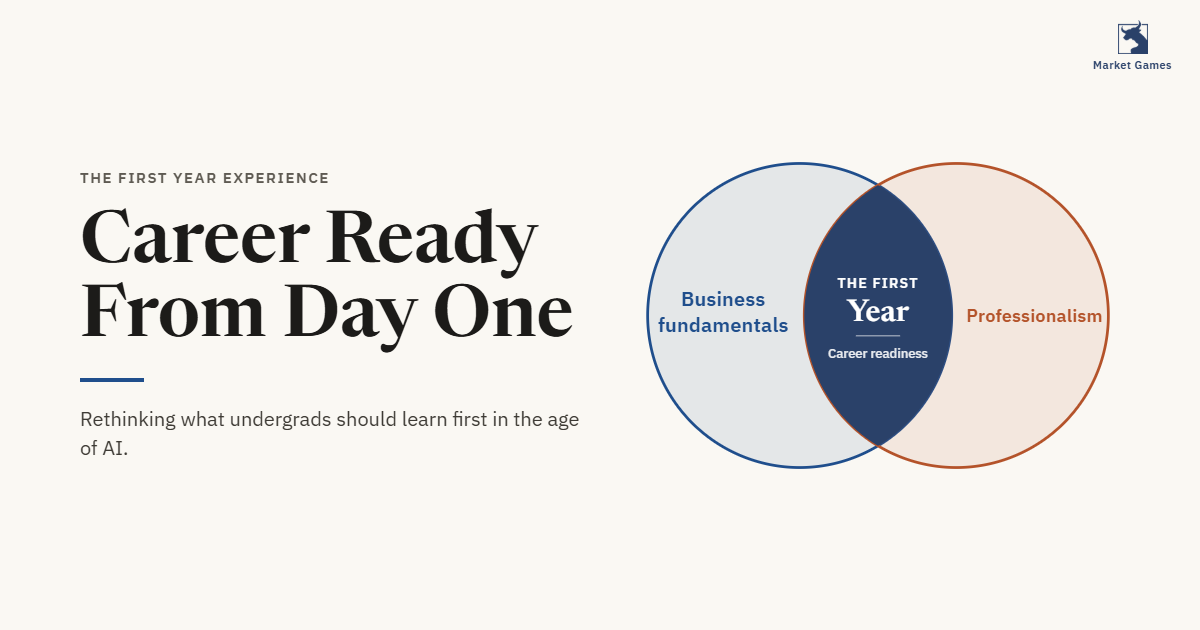
Both camps are right. Students need to understand how organizations work, and they need to be ready for their careers. But career readiness is more than resumes and interview prep. It also means being able to think critically about how an organization functions. And fundamentals don't have to be taught as terms to memorize. Students can learn them by using them to make real cross-functional business decisions. The first year doesn't have to choose. It can do both.
The career readiness problem
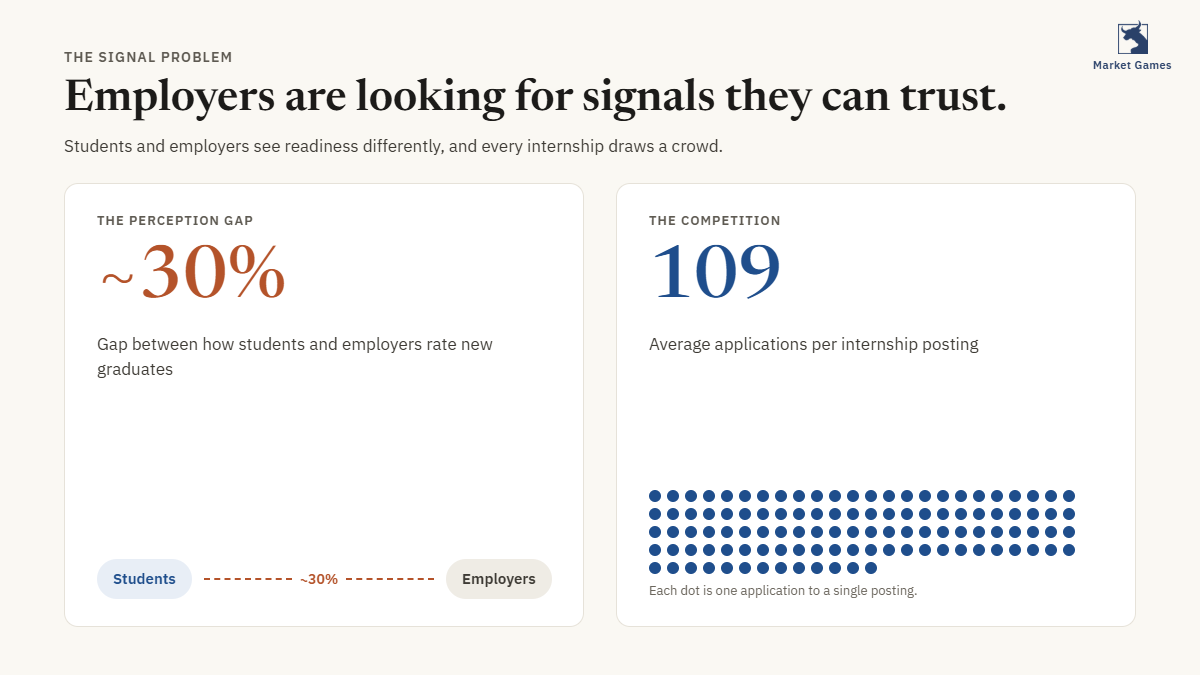
Employers want the skills that make a new hire useful: critical thinking, communication, teamwork, and professionalism. These are central to the NACE career readiness framework, and they are the hardest skills to read from a GPA. When grades cluster at the top, they differentiate less. As AI absorbs routine tasks that entry-level employees once used to prove themselves, students compete for fewer internships, and employers look for any credible signal that a candidate can handle ambiguity and contribute early. The first year can't be a warm-up. It is where career readiness begins or gets postponed.
The habits no one caught
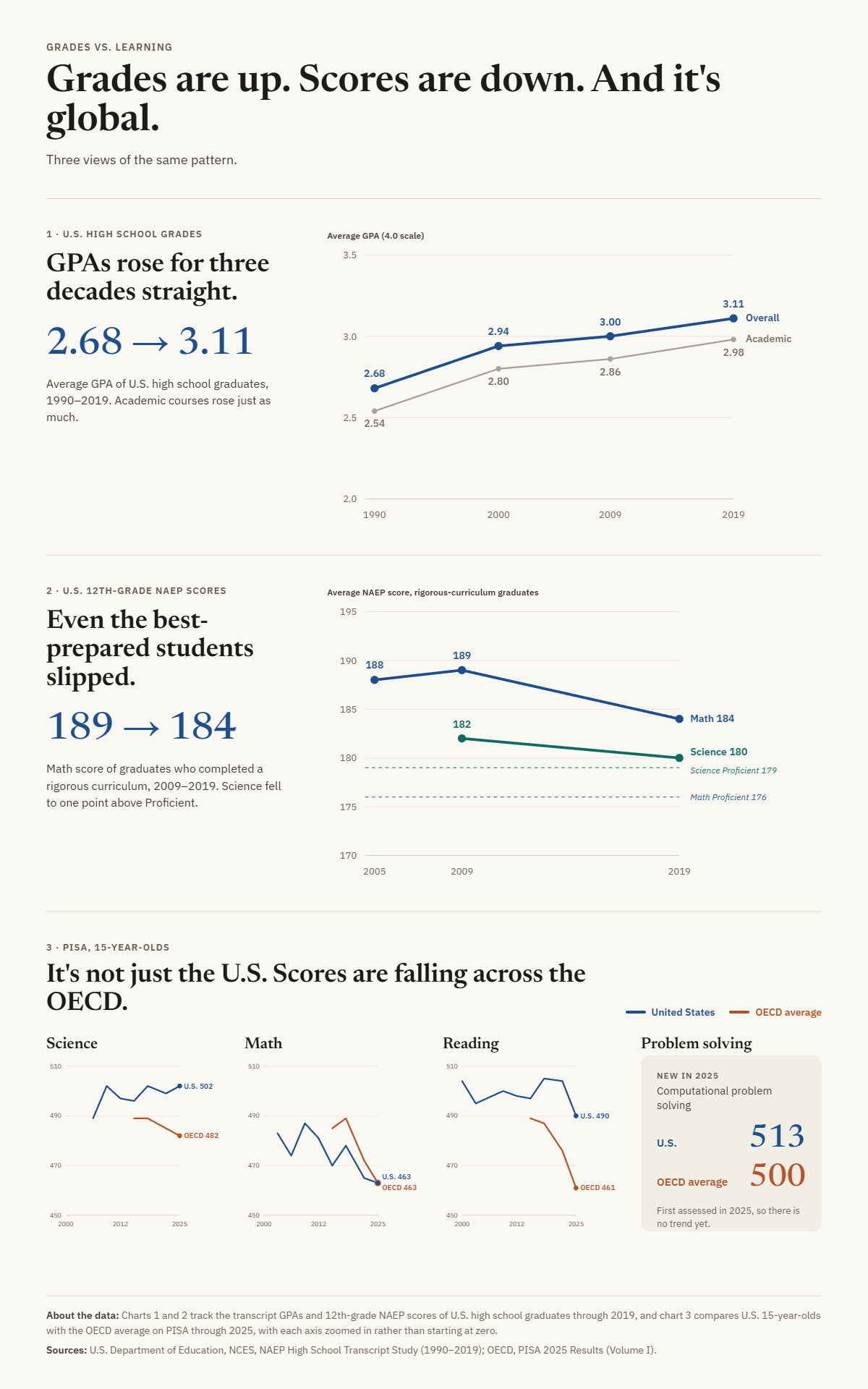
High school grades have risen even as achievement has stalled. The ACT has warned about grade inflation, but critics note its conflict of interest and reliance on students' self-reported grades. The federal government found the same trend, though. The National Center for Education Statistics' High School Transcript Study analyzed actual transcripts from a nationally representative sample of 2019 graduates. Average GPAs climbed to 3.11, the highest on record, while NAEP math scores fell, even among students who took the most demanding courses.
Some of the policies behind this trend, such as unlimited retakes and no late penalties, were well-intentioned. But they could also teach that deadlines are negotiable and turning something in is the same as learning it. Today's students also came of age through pandemic disruptions, the sudden arrival of generative AI, and constant smartphone distraction.
As a result, some capable students arrive at college with habits that never showed up on a report card. Professors describe a familiar pattern: cramming instead of studying steadily, waiting for reminders rather than tracking deadlines, putting off asking for help, and handing their thinking to AI. None of this is a character flaw. These are habits formed in systems that appear to not carry consequences. This is the reality business programs now face. Students who earned strong grades in high school can be caught off guard when the same habits stop working in college, and that gap between expectation and experience can fuel the anxiety and stress programs are working hard to address.
Reliability, time management, and the ability to use feedback are exactly what employers want. A first year designed only to be gentle may postpone the moment students discover their habits don't serve them until an internship search or first job, when the cost is higher. The goal on day one is to make those habits visible while the stakes are still low, through clear expectations, real deadlines, fast feedback, and team experiences where one member's missed commitment affects everyone.
Low stakes, not low rigor
When the University of Michigan's College of Literature, Science, and the Arts announced a pilot to cover first-semester letter grades, it framed the initiative as a response to the mental health crisis among college students. Supporters point to several goals. Removing GPA panic may ease the anxiety and depression linked to academic pressure. A buffer semester gives students time to adjust to college-level workloads and to living away from home. Tim McKay, the college's associate dean for undergraduate education, has said the university wants students to explore subjects beyond their comfort zone rather than playing it safe to protect their GPA. And the school hopes to shift students away from competitive grade-chasing toward intrinsic motivation and collaboration.
These are good goals, and many business programs share the underlying worry: first-year students make mistakes, and those mistakes can follow them into internship applications.
Michigan's approach points to an important distinction: protecting students from early mistakes is a question of stakes, not difficulty. Some programs blur the two and protect first-year students by making the work itself easier, with lighter courses, fewer demanding assignments, and little real challenge. That can undercut the very goals administrators have in mind. Risk-taking, resilience, and intrinsic motivation depend on students facing challenges worth taking risks on. A course with no real difficulty offers nothing to be brave about. Learning research has long pointed to the value of "desirable difficulties," the productive struggle that produces deeper and more durable understanding than easy practice (Bjork, R.A 1994, Memory and Metamemory Considerations in the Training of Human Beings).
Some programs blur the two by making the work itself easier. That can undercut the goals administrators want. Risk-taking and resilience depend on challenges worth taking risks on, and research on what psychologist Robert Bjork calls "desirable difficulties" shows that challenges that feel harder in the moment produce deeper, more durable learning. A better path keeps the work demanding while treating early mistakes as part of learning rather than a permanent mark. A better path keeps the difficulty and changes how it counts. Instead of easing the work, programs can assign demanding, realistic tasks while grading them in ways that forgive early failure: weighting early rounds lightly, rewarding improvement over time, allowing revision, and emphasizing feedback over final scores.
AI is a design problem, not an integrity problem
Nowhere is the tension in business education sharper than with AI. Employees across industries use it daily, and employers expect graduates to use it well. Yet in classrooms, AI is often discussed as a cheating tool.
Both concerns are valid, and they point to the same conclusion: detection and bans won't solve this. AI detectors are unreliable, prohibitions contradict workplace reality, and students who never learn to use AI thoughtfully graduate at a disadvantage.
The more durable fix is assignment design. Many traditional first-year tasks, such as concept learning, a summary of a reading, or a boilerplate business plan, ask for a product that AI can generate in seconds. Those assignments invite shortcuts and teach little when shortcuts are taken.
Assignments built around judgment work differently. When students must make decisions with no single right answer, in a context that shifts as competitors act and conditions change, AI cannot do the work for them. It can explain a concept, summarize research, or suggest options, and students should be encouraged to use it that way. But it cannot see the full picture, weigh the team's priorities, or own the consequences. The decision, and the reasoning behind it, remains the student's.
Programs can reinforce this by asking students to document how they used AI, what they accepted, what they rejected, and why. Oral defenses and team debriefs make it quickly clear whether students understand their own choices. In this design, using AI well and learning well become the same activity.
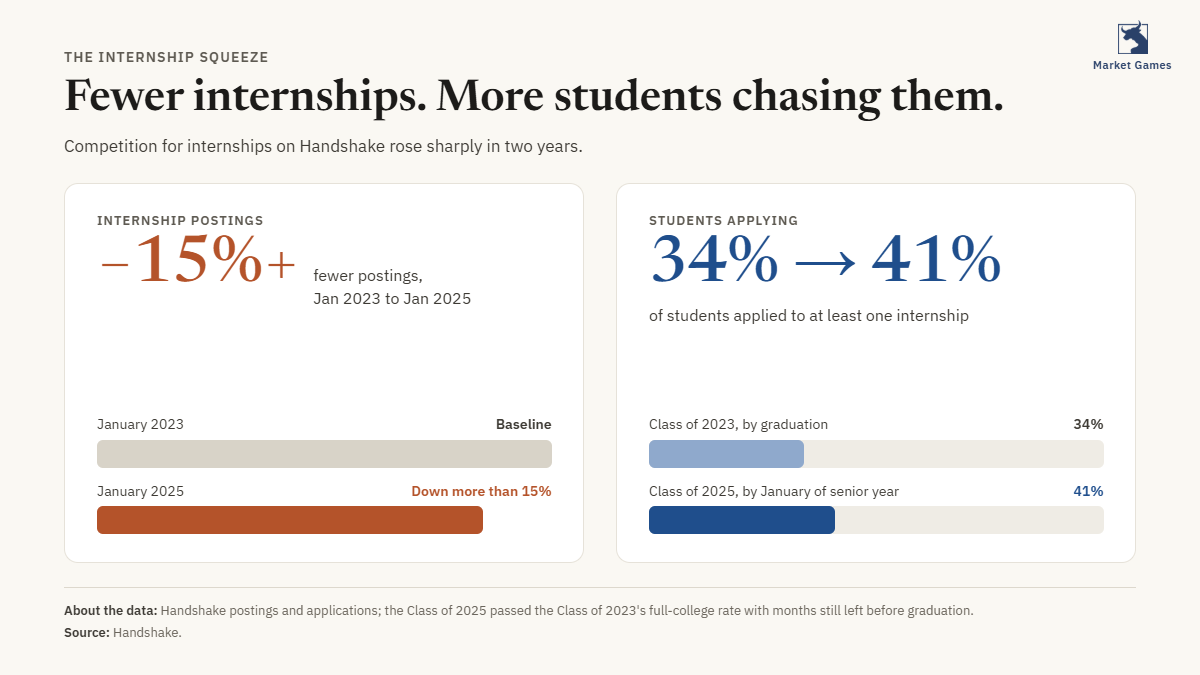
Source: Handshake Internship Index 2025
That makes applied judgment, built on a solid grasp of the core business functions, a strong candidate for the heart of the first-year curriculum. It is rigorous in the truest sense, because it requires students to use what they know rather than just recall it. It is resistant to AI shortcuts. And it is the skill most likely to set students apart, first in the competition for internships and later in the job market, as routine work becomes increasingly automated.
Putting it together
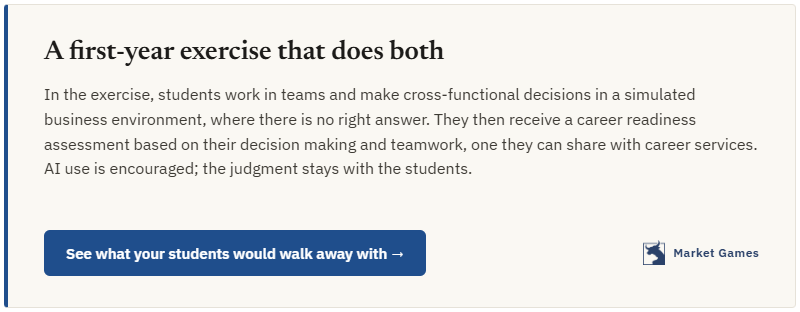
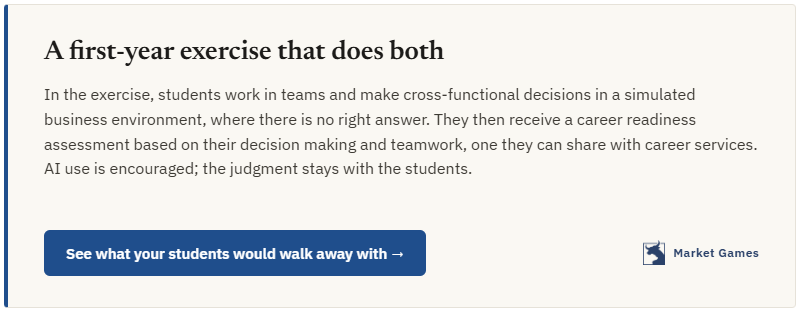
A first year that serves both camps centers on an integrated, decision-based experience: a live client project, a case competition, or a business simulation in which teams make decisions with no single right answer and outcomes are uncertain. This creates a struggle and nudges them to think more deeply about how organizations function. They practice professionalism and management because working in teams under deadlines demands it. And they face real difficulty at low stakes while using AI and owning their judgment.
The same experience also answers a problem grades can't solve. Every decision leaves a record of reasoning, teamwork, and reflection. Assessed against NACE's career readiness competencies, that record becomes evidence employers understand. The assessment should be developmental first, showing every student their strengths and gaps, with recognition for strong performers as a secondary benefit rather than a new source of pressure.
The first year is where readiness begins
The pressures on business education are not going away. AI will keep changing the entry-level workplace. Employers will keep looking for signals beyond the transcript. And the public will keep asking whether college is worth it.
Business programs don't have to choose between protecting students and challenging them, or between teaching AI and preventing its misuse. The first year can be a place where students confront the habits they brought with them, take real risks at low stakes, learn to think alongside AI rather than behind it, and begin building proof of what they can do. That is not an easier first year or a harder one. It is a first year designed for the careers students are actually entering.