
Why Business Fundamentals Matter More in the Age of AI
For the last few years, we've heard that AI will make what we know less important. Why learn accounting when AI can analyze a financial statement? Why learn finance when AI can value a company in seconds?
There is some truth to this.
AI will dramatically transform the way we learn and work. But the value of AI isn't just in getting answers. It's knowing which questions to ask, what answers to challenge, and how to use them to make better decisions.
AI doesn't level the playing field. It multiplies what you already bring.
For students entering an AI-powered job market, having strong business foundations will give them a competitive advantage. Employers don't just need people who can use AI. They need people who can use it effectively.
Knowledge Is the Multiplier
For anyone who thinks AI makes knowledge obsolete, Anthropic's research report suggests otherwise. After analyzing millions of conversations, the report found that what users bring to AI shapes what they get back.
AI meets you at your level. When researchers measured the education level of a user's prompt against the education level of Claude's answer, the two moved together almost perfectly (a correlation above 0.92, across 117 countries and all 50 US states).
Prompts requiring a high school level of education produced roughly a 9x speedup on tasks. Prompts requiring a college level produced roughly 12x. Productivity gains, the researchers concluded, are more pronounced for use cases requiring higher human capital.
Same tool. Different returns, depending on what the user brought to it. That's the pattern. What you bring shapes what you get back. And in business, having an understanding of how organizations function brings a lot.
Knowing What to Ask and What to Challenge
Organizations are complex, which is why the problems management faces rarely have right answers. Decisions cut across functions, each with its own tradeoffs. What Marketing promises may be more than Product can build and Operations can deliver on time. And every function competes for the same finite resources from Finance. Add competitors, suppliers, regulation, and a market that moves whether you're ready or not.
Someone without business fundamentals struggles to see those connections. Given a variance analysis task, they might ask AI something like this:
My boss asked me to explain why our company made 18% more money this year compared to last year, but our spending on making the products actually dropped by 4%. Why would that happen? What should I check?
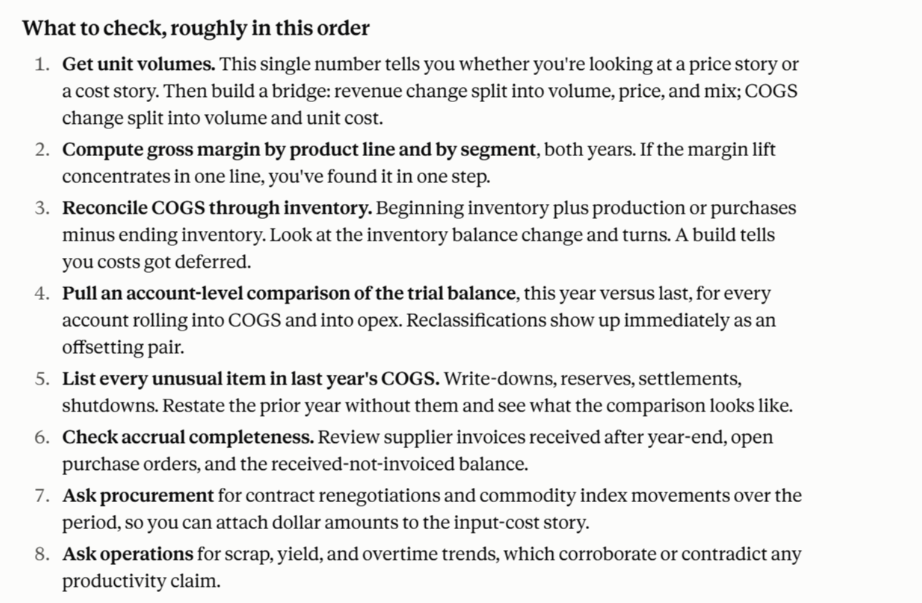
[Claude's Response] —>
Nothing in that answer is wrong. It's a better checklist than most first-year associates could write. But the person now has a longer list than they started with, and almost every line contains a term they haven't learned. What is gross margin, and how is it different from net margin? What does product mix mean? What counts as cost of goods sold, and what goes in operating expenses? And who decides that? What is GAAP?
Each answer takes another exchange, and each exchange opens two more. The list grows faster than their understanding of it.
That's half the problem. The other half is knowing what to challenge, because wrong answers arrive with the same fluency as correct ones. In 2023, CNET published 77 finance explainers written with an internal AI tool and corrected 41 of them. One explainer on compound interest told readers that depositing $10,000 at 3% compounding annually would earn them $10,300 after a year. Anyone who has taken a finance course catches that instantly. Anyone who hasn't, reads a confident sentence and moves on.
Employers Agree
If business knowledge were losing value, employer demand would show it. It doesn't. 6 of the 10 most in-demand bachelor's degrees for the Class of 2026 are business-related, according to NACE's Winter 2026 Salary Survey, with finance at the top.
The more revealing data is the importance employers place on AI skills in relation to other competencies. NACE asked employers to rate career readiness competencies on a five-point scale. Communication and teamwork came in at 4.5, critical thinking at 4.4, professionalism at 4.3. AI skills finished last at 2.8, below "somewhat important."
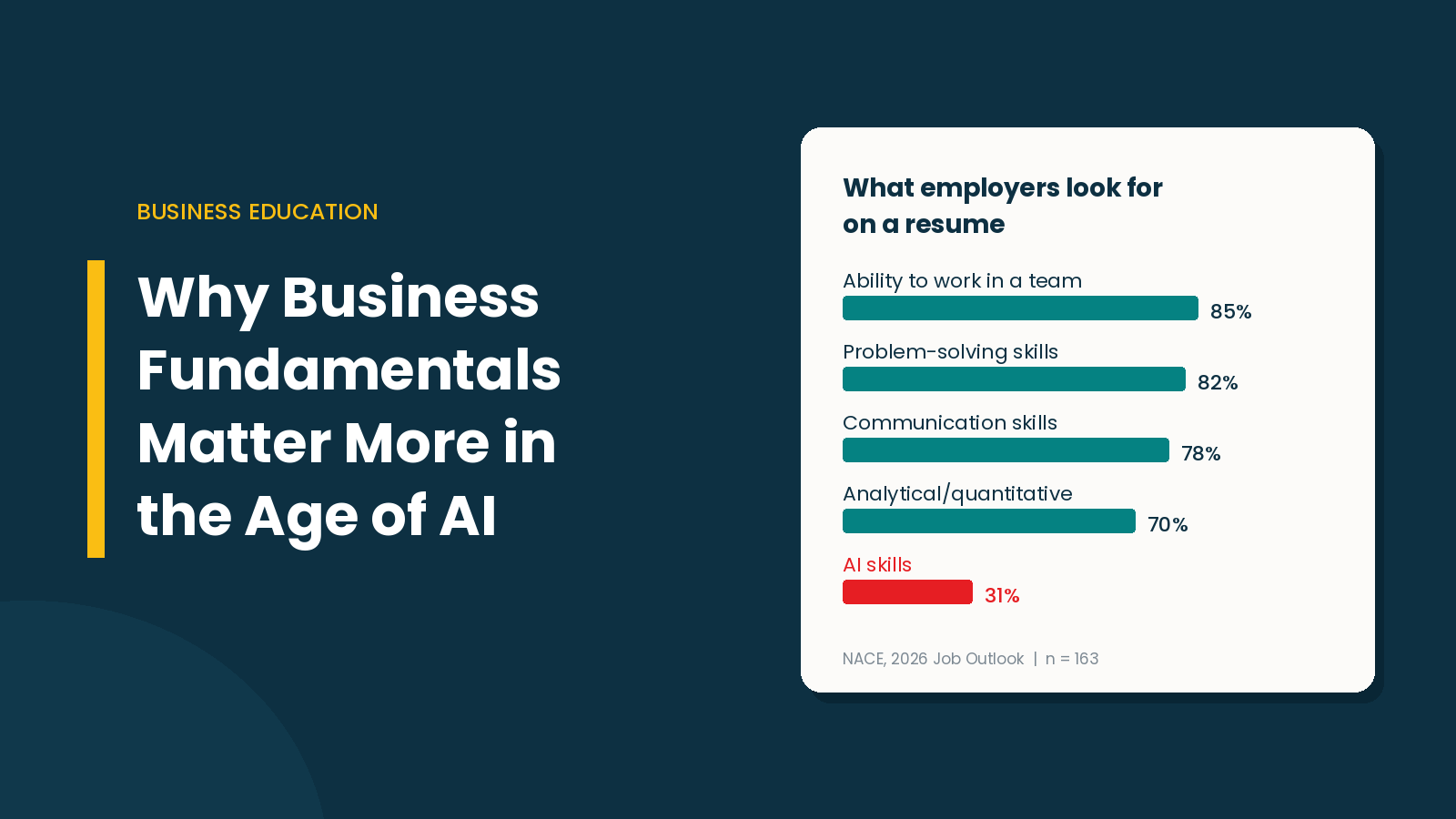
When asked what they seek on a candidate's resume, employers again put other competencies ahead of AI skills. Graduates are already more skilled at AI than employers need them to be. What employers can't find is judgment.
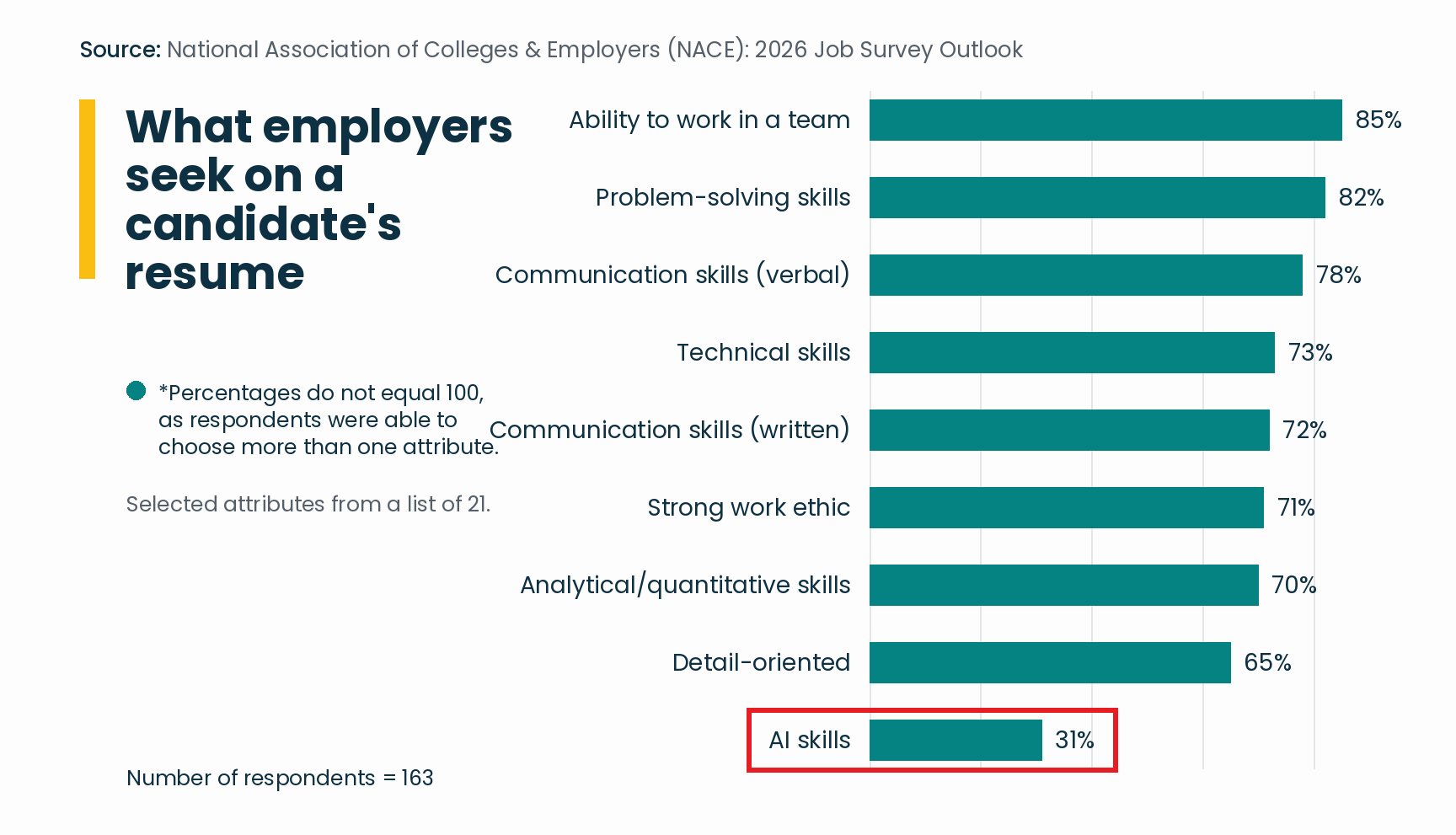
Even among those actively seeking AI skills, what they want isn't tool fluency. Two-thirds want people who can analyze and revise AI outputs. You cannot revise an answer you can't evaluate, and you cannot evaluate an answer about pricing, capacity, or working capital without knowing what those things are.
What This Means for Undergraduate Business Programs
Students should graduate fluent in these tools. That isn't in question, and employers are already assigning AI work to interns.
But the tempting conclusion is that if a model can define gross margin, students no longer need to learn it. We settled a version of this question decades ago. Calculators have been able to multiply and divide since the 1970s, and we still teach multiplication tables, fractions, and percentages. Not because children need to compute by hand, but because someone who hasn't internalized what a ratio is can't tell when a result is off by a factor of ten.
The same holds here. A definition retrieved on demand isn't the same as knowing which concept applies when nobody has told you what the question is about.
That knowledge takes repetition to build. Drills and problem sets haven't stopped mattering just because a model can produce the answer. What has to change is what comes after. Mechanics get students to the starting line. The learning happens when they're handed a problem with no right answer, where several concepts are in play and they have to decide which ones matter.
That's where AI earns its place in the classroom. A student who doesn't know what a cost variance is, but needs one to make a decision, will go find out. The questions that read as confusion in an unstructured setting become the engine of the assignment when there's a reason to push through them. The concepts stick because the student needed them.
Knowing how the functions connect, what the numbers mean, and which tradeoffs are in play is what lets a graduate frame a problem, read an answer, and catch the one that's off. AI raised the return on that knowledge. It didn't replace it.