The Market Games Blog
Business education insights, customer stories and company news for your search of teaching support.
Featured Articles
UNC Kenan-Flagler’s first-year BUSI 100 course pairs Plato and Du Bois with the Market Games simulation, so students experience how business functions connect and question how success should be measured.
University College Cork’s first-year BU 1000 course uses the Market Games simulation to build critical thinking, as part of a Bachelor of Commerce built around experiential learning.
Since 2022, first-year students in Purdue’s Integrated Business and Engineering program have used the Market Games simulation to see how marketing, finance, and operations work together.
First-year students in Miami University’s Farmer School of Business use the Market Games simulation to build critical thinking and teamwork before they tackle a real client project.
Recent Articles
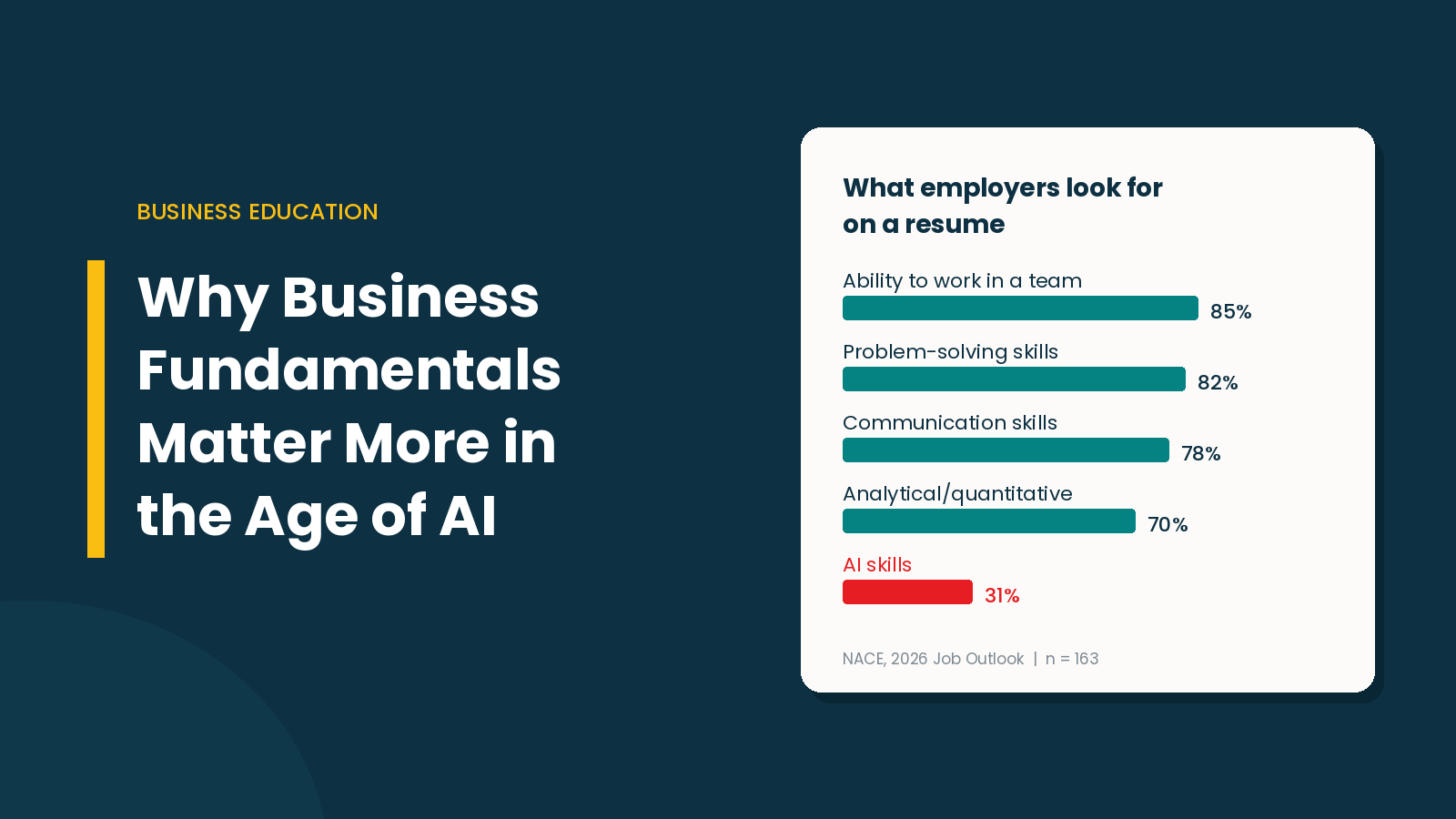
AI doesn’t make business knowledge obsolete. It multiplies it. Students who understand how organizations work ask better questions, catch wrong answers, and get more from AI, which is why fundamentals matter more, not less.
UNC Kenan-Flagler’s first-year BUSI 100 course pairs Plato and Du Bois with the Market Games simulation, so students experience how business functions connect and question how success should be measured.
Debits and credits still matter, but AI and accounting software are changing what students need most. Here’s how instructors use the five elements and the accounting equation to teach the bigger picture.
Generative AI can complete most traditional assignments. Here’s why business simulations, built on decisions with no right answer, make a strong group project for large intro business courses, and how to choose one.
Active learning, fast feedback, and career readiness evidence students can take with them: three reasons instructors use Market Games to make the first year count.
University College Cork’s first-year BU 1000 course uses the Market Games simulation to build critical thinking, as part of a Bachelor of Commerce built around experiential learning.
This #Thanksgiving, we're reflecting on the incredible journey we've had at Market Games and expressing our heartfelt gratitude. From the thousands of students embarking on learning adventures with our Intro to Business Simulation to our college partnerships and transformative Techstars investments, check out our latest blog post to discover the 7 things we're thankful for this holiday season
Since 2022, first-year students in Purdue’s Integrated Business and Engineering program have used the Market Games simulation to see how marketing, finance, and operations work together.
How can business educators best prepare learners with both the foundational knowledge and self-direction needed for career success?
Both professors and students are unfortunately familiar with the struggle that always arises with group projects. Oftentimes, there are issues with participation. Some students do all the work, while others slack off. This is a constant challenge for professors. A solution we have identified is to incorporate peer feedback into the classroom.
The rise of technology and automation makes it more important than ever for business education to prepare students for 21st century business demands. A big part of that is developing critical thinking skills - which does not happen overnight. Therefore, students need to learn critical thinking early on in their freshman or sophomore year in order to practice this thinking habit throughout their college career.
Large intro business courses can build critical thinking, teamwork, and a sense of belonging. Here’s how active and collaborative learning makes it possible without adding to professors’ workload.
Since spring 2019, Berkeley Haas students in UGBA 10, the Principles of Business course, have used the Market Games simulation to apply theory to real business decisions under uncertainty.
First-year students in Miami University’s Farmer School of Business use the Market Games simulation to build critical thinking and teamwork before they tackle a real client project.
The art of effective teamwork relies on the extensive skills and strengths of each team member and how they interplay with one another. One of these key skills is critical thinking, which is the most demanded within our current job market.
One buzz word that often comes up in education and professional settings is critical thinking. What is critical thinking? Many people toss this word around but few understand what it truly means to have critical thinking skills.
AI, a tighter job market, and inflated grades are pushing business programs to rethink the first year. The answer isn’t making it easier or harder. It’s making it matter, with decision-based work that builds fundamentals and career readiness.